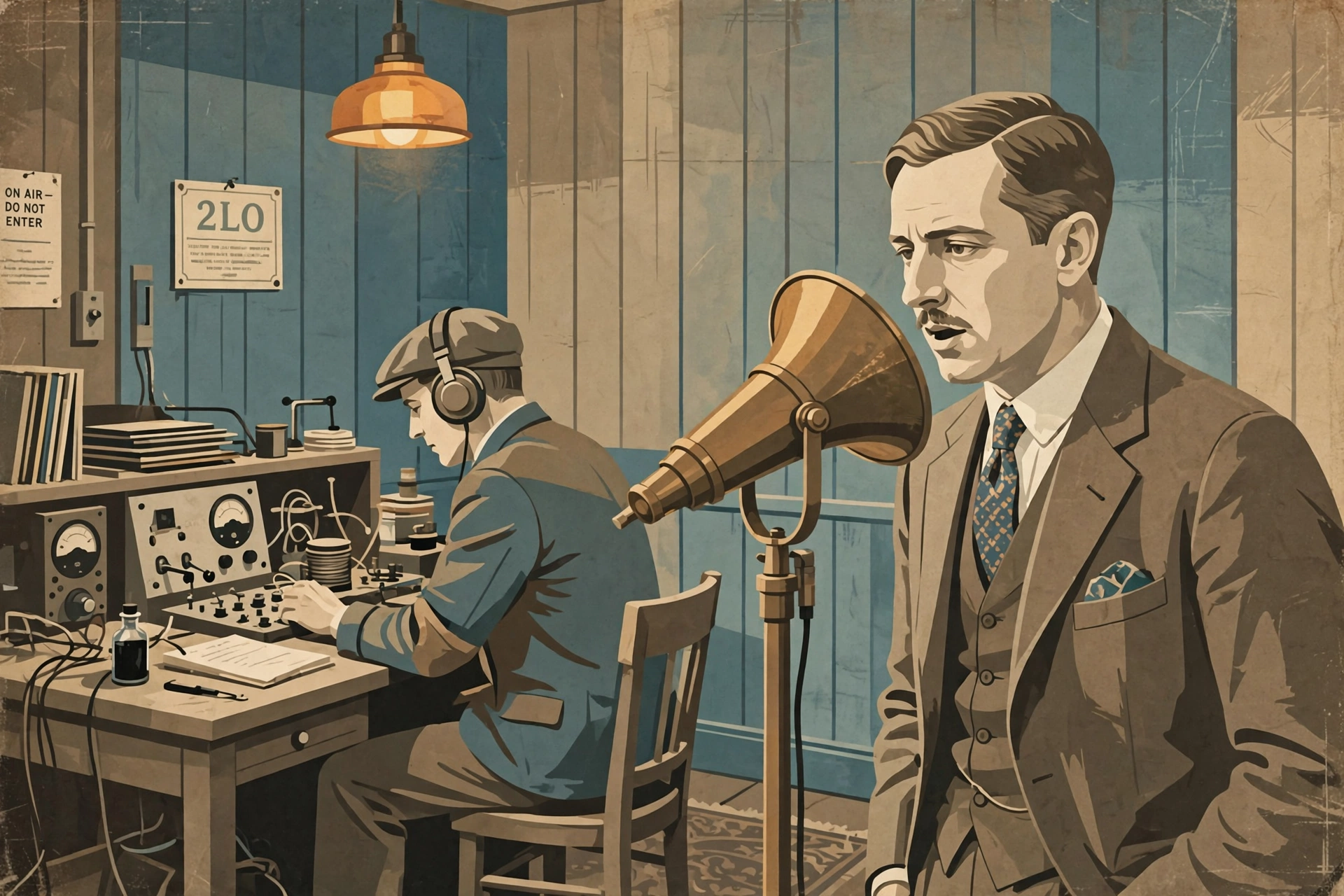
From 2LO to the World: A Century of the BBC
How a crackly voice from a London rooftop in 1922 became the world's most trusted broadcaster — from 2LO to the Empire Service to today.
記事を読む →記事の本文は英語です。
How a crackly voice from a London rooftop in 1922 became the world's most trusted broadcaster — from 2LO to the Empire Service to today.
記事を読む →A small radio beacon made an orbiting satellite audible from Earth. Its beeps differ from both speech and a broadcast programme.
記事を読む →The 1912 disaster connects communication equipment with the human and institutional work of listening for distress.
記事を読む →Maxwell’s electromagnetic theory and Hertz’s experiments answer different questions from the invention of a receiving set.
記事を読む →A simple electrical circuit explains the key, but different telegraph systems used different ways to represent information.
記事を読む →Dots and dashes are only part of the system. Spacing tells a listener where a character or word ends.
記事を読む →Armstrong’s frequency modulation work helps explain why a station’s programme and its delivery method are different things.
記事を読む →Explore Brazil, France and Australia through holding institutions, while checking what each recording actually represents.
記事を読む →A radio receiver, a wireless telegraph and a broadcasting service have different histories. The invention question becomes clearer when we separate them.
記事を読む →London station 2LO provides a specific starting point for exploring the relationship between broadcast equipment and regular programmes.
記事を読む →The 1954 Regency TR-1 offers a way to explore the relationship between new components, portable design and everyday listening.
記事を読む →A practical invitation to record the ordinary details of listening, while keeping personal recollection distinct from independently verified history.
記事を読む →A surviving receiver helps us think about the practical experience of early listening, from setting up equipment to following a programme.
記事を読む →Thinking about radio as part of everyday life means looking beyond its circuitry to rooms, routines and the people who listened.
記事を読む →Broadcasts could inform, persuade or mislead. Understanding a wartime recording begins with its maker, intended audience and historical setting.
記事を読む →A free exhibition linking the machines and histories of radio with the living experience of listening around the world.
記事を読む →Wireless signals, receivers and regular broadcasting developed in different stages. A useful history starts by asking which stage we mean.
記事を読む →World Radio Nowでは世界のライブ放送を聴けます。歴史の声をたどったら、今の音楽、ニュース、文化を探しましょう。