1895
Signals without a wire
Marconi experimented with wireless signals in 1895. Explore the step from laboratory work to communication over distance; wireless telegraphy and spoken broadcasting are different stages of this story.
Read the story →Explore the machines, ideas and everyday memories that connect people through radio. Follow a story from the past, then listen to the world today.

Discover how experiments with electromagnetic waves grew into communication across distance.
02Explore how receivers and regular programmes changed everyday listening.
03Consider broadcasting, public information and the different uses of radio during conflict.
04Follow portable listening into today’s world of online stations.
Marconi experimented with wireless signals in 1895. Explore the step from laboratory work to communication over distance; wireless telegraphy and spoken broadcasting are different stages of this story.
Read the story →
This Science Museum Group record describes a crystal receiver made in Manchester around 1920–1925. A small object opens a question: how much skill did early listening require?
Read the story →
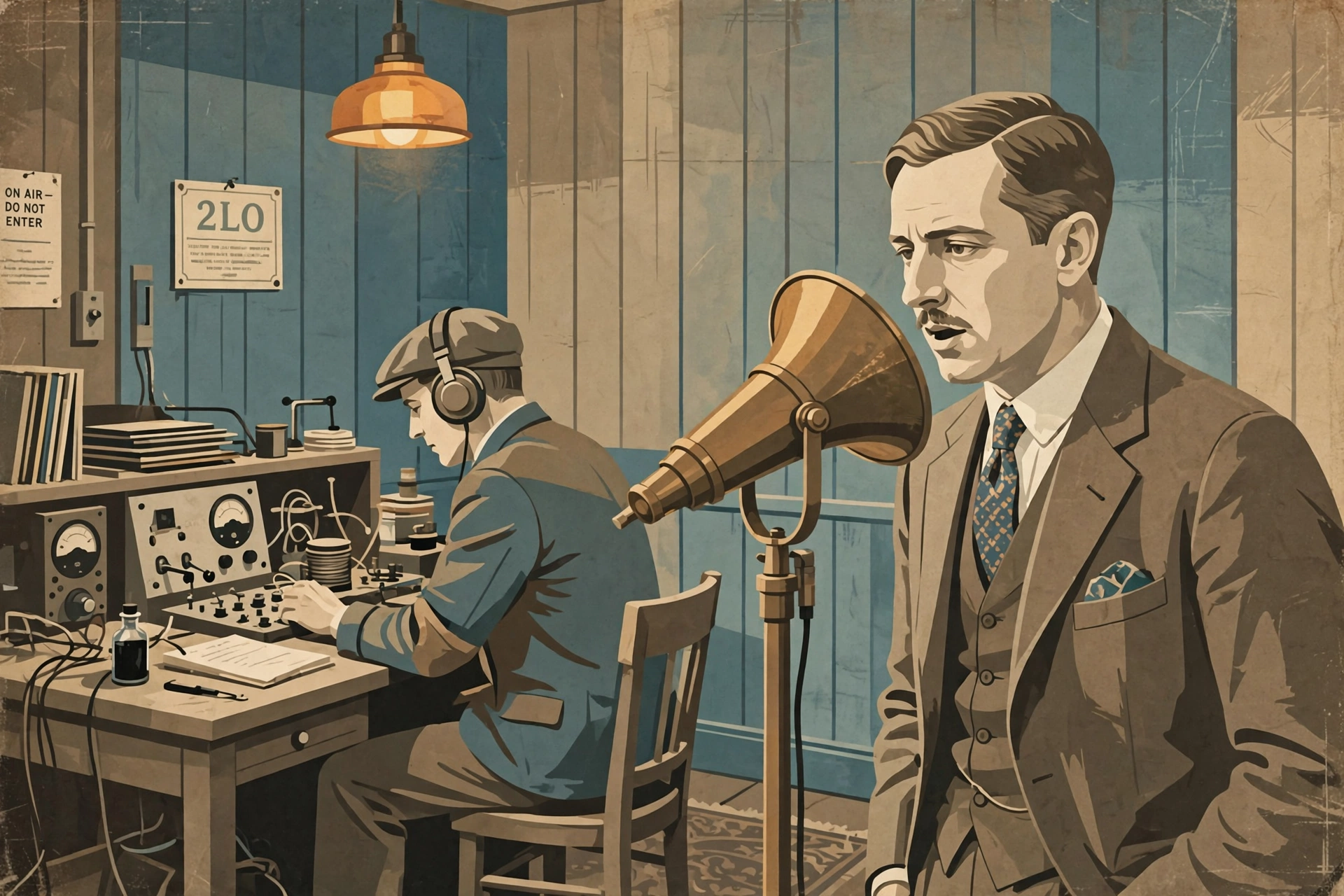
The Science Museum dates the first BBC broadcast from 2LO to 14 November 1922. A transmitter helps us connect technical equipment with the growth of regular programmes.
Read the story →
IWM preserves a recording associated with Deutscher Freiheitssender 29.8 from 3 October 1939. Examine who made a broadcast, its audience and purpose before treating its message as evidence.
Read the story →
The Smithsonian records the Regency TR-1 as a 1954 transistor radio. Portability invites us to consider how a shared household activity could become a more personal listening experience.
Read the story →
Today, World Radio Now links listeners to public station streams. Compare the experience with earlier receivers: the path to a programme changes, while voices, music and local identity remain worth exploring.
Read the story →
Several systems developed along different paths. Cooke and Wheatstone demonstrated a needle telegraph in Britain in 1837. Morse and Vail demonstrated their coded system between Washington and Baltimore in 1844. A key closes an electrical circuit; the receiver detects the changing current.
Read the story →
Radio waves are a natural phenomenon. Maxwell’s electromagnetic theory, published in 1865, and Hertz’s experiments in the 1880s are different steps: prediction and experimental demonstration. Practical wireless communication came later.
Read the story →
Short and long signals represent letters and numbers. Morse and Vail’s early American system differs from the modern International Morse code used in our game. ITU specifies both the signals and their spacing.
Read the story →
The 1912 disaster exposed weaknesses in wireless watchkeeping and coordination. ITU’s account connects it with further international radio safety measures. Written messages and later sound recreations are different kinds of evidence; no Titanic transmission is presented here as an original audio recording.
Read the story →
Edwin Armstrong’s work on frequency modulation in the 1930s addressed interference in radio reception. FM varies the frequency of a carrier; AM varies its amplitude. Internet streaming delivers encoded audio through a different network.
Read the story →
The Soviet Union launched Sputnik on 4 October 1957. Its radio beacon could be monitored by radio enthusiasts. The archive sound is a signal, not a voice or a studio programme.
Read the story →There is no single inventor behind every part of a radio. Wave theory, experiments, detectors, tuning and amplification developed through different contributions. Marconi and Braun shared the 1909 Nobel Prize for work on wireless telegraphy. A telegraph signal is not yet a spoken radio programme, and a receiver is not the same object as a transmitter.
Read the story →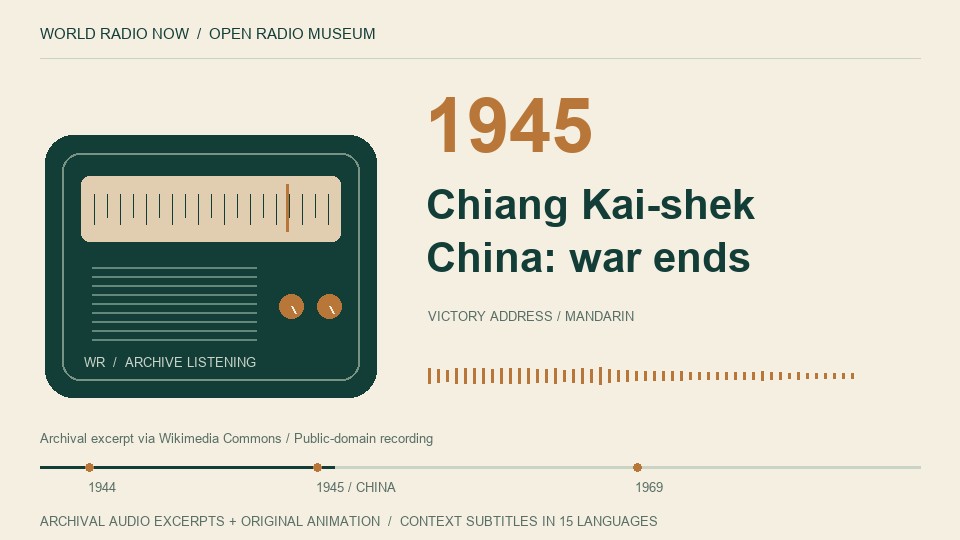
Original voices, documented moments. Choose a recording to listen; nothing plays automatically.
Hear history through radio →Journal articles are in English.
How a crackly voice from a London rooftop in 1922 became the world's most trusted broadcaster — from 2LO to the Empire Service to today.
Read the story →A small radio beacon made an orbiting satellite audible from Earth. Its beeps differ from both speech and a broadcast programme.
Read the story →The 1912 disaster connects communication equipment with the human and institutional work of listening for distress.
Read the story →Maxwell’s electromagnetic theory and Hertz’s experiments answer different questions from the invention of a receiving set.
Read the story →A simple electrical circuit explains the key, but different telegraph systems used different ways to represent information.
Read the story →Dots and dashes are only part of the system. Spacing tells a listener where a character or word ends.
Read the story →Use this printable sheet with the exhibition. Read the linked source records, compare what objects reveal and discuss the questions together.
Turn letters into sound, solve a listening challenge and try a telegraph key. No account needed.
World Radio Now helps you listen to live stations around the world. Explore a historical voice, then discover music, news and culture on today’s airwaves.